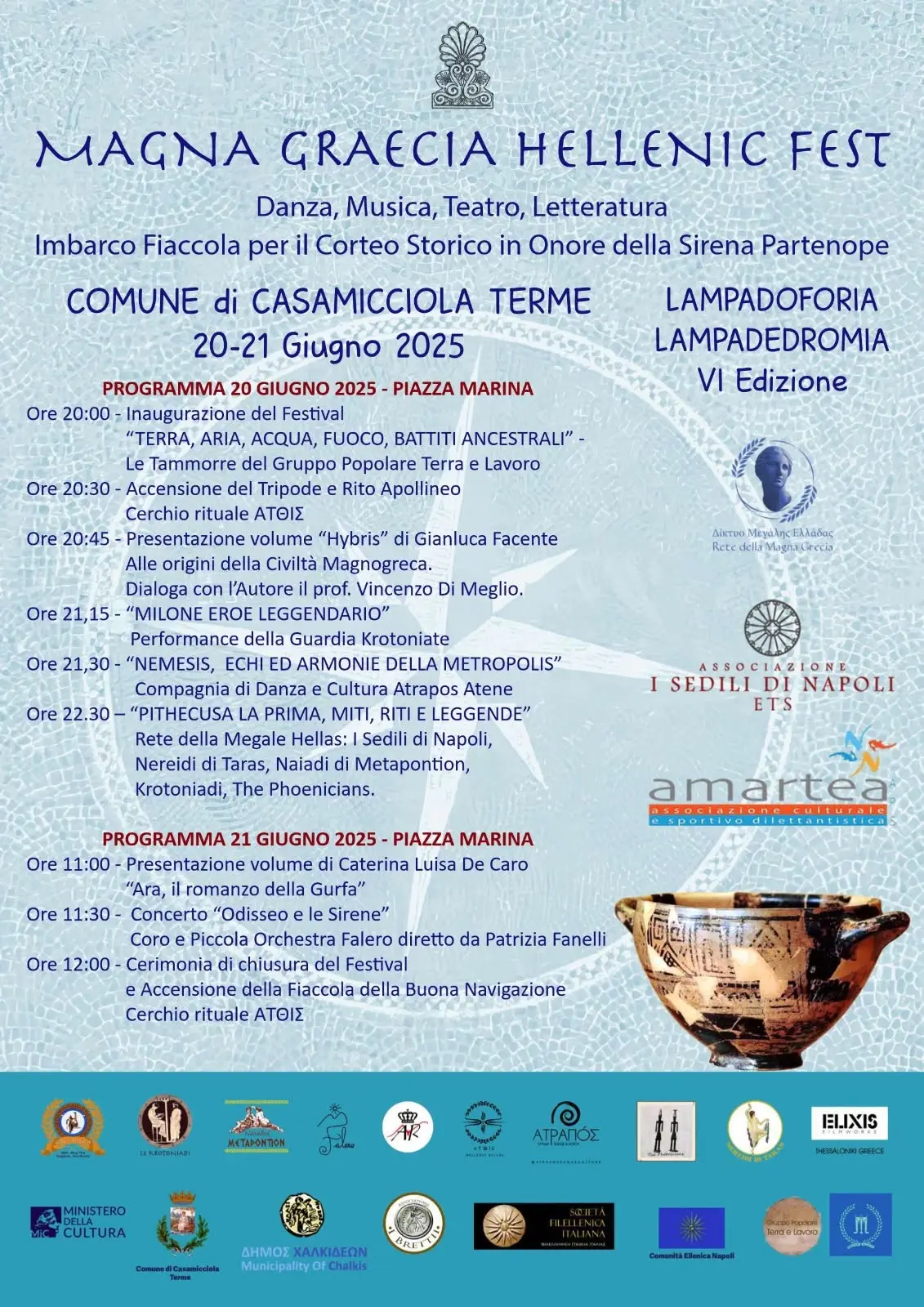
On Friday 20 and Saturday 21 June, in the new Piazza Marina, the Megale Hellas Network – which brings together associations and historical re-enactors from Agrigento, Gela, Crotone, Metaponto, Naples and Taranto – will stage the first ‘Magna Graecia Hellenic Fest’, a programme of dance, music, theatre and literature that for two days will turn the square into a true ‘Magna Graecia Agora’.
This striking event, the only one of its kind, will involve more than 100 people, including musicians and historical re-enactors in archaic Greek dress, hoplites in armour and dancers from Athens in Minoan costume. Together they will recall the island’s deepest historical and cultural roots: the first Greek settlers who landed here in ancient times named it Pithekoussai, and from here the civilisation of Magna Graecia spread.
The programme opens at 8pm on Friday 20 June with a folk music performance by the Gruppo Popolare Terra e Lavoro from Naples, followed by the ancient ritual of lighting the tripod, performed by the ATOIS association of Athens, and the presentation of the book Hybris by Gianluca Facente, in conversation with Prof. Vincenzo Di Meglio. Straight afterwards comes a theatrical performance on the legendary athletes and heroes of Magna Graecia by the Guardia Krotoniade and I Bretti. At 9.30pm the show continues with the ancient music and dance group Atropos from Athens and, to close the first day, the Myths and Legends of Pithecusa, performed by the artists of the Megale Hellas Network.
On Saturday 21 June the Festival continues with the presentation of Caterina Luisa De Caro’s book Ara, il romanzo della Gurfa, followed by a concert by the Coro Polifonico e Piccola Orchestra Faero, conducted by Patrizia Fanelli. The Festival closes with the lighting of the Olympic torch, accompanied by a ritual in Greek by the ATOIS group, and the symbolic embarkation of the torch for Naples: from Pithecusa, the ‘baton’ of Magna Graecia’s civilisation passes to the polis of Parthenope/Neapolis.
The event is held under the patronage of the Italian Ministry of Culture, the municipalities of Chalkis (Greece) and Casamicciola Terme, the Società Filellenica Italiana and the Hellenic Community of Naples.