


At a glance
Giulio Grablovitz (Trieste 1846 – Ischia 1928) was the scientist called in to design and direct the Casamicciola Geodynamic Observatory, founded in 1884 at the Grande Sentinella. He invented pioneering instruments such as the seismic tank and lived on the island until 1928, devoting himself to the study of the earth, the climate and the tides.
A scientist from Trieste
Giulio Grablovitz was born in Trieste in 1846, when the city was part of the Austro-Hungarian Empire, and lived there until he was about forty. An irredentist (a supporter of Trieste's union with Italy), he was sentenced to death in absentia by the Austrian authorities. He worked first in astronomy, publishing his first paper in 1874, and made his name with his Nuova teoria sismica delle maree (New seismic theory of the tides, 1876), expanded the following year. In his research he argued that earthquakes originate from forces inside the Earth and not from the action of the Sun and Moon.
The Casamicciola appointment
After 1883 Parliament funded a “first-order” geodynamic observatory in Casamicciola, like those of Rocca di Papa and Catania. Grablovitz, already known for his studies of astronomy, earthquakes and tides, was summoned from Trieste to design and direct it, and he also sat on the government commission that drew up the programme of seismic studies in Italy.
Building the main observatory at the Grande Sentinella took a long time. Meanwhile, from 1885, Grablovitz set up a temporary station in the former Casina Reale (Royal Lodge) at Ischia Porto, where he also recorded the temperatures of the thermal waters and the tides; that station remained in operation even after the Casamicciola observatory was completed. According to INGV, regular meteorological observations began at the Grande Sentinella Observatory on 1 January 1888, and the seismology section was active from 1889 to 1936.
The instruments
Grablovitz designed the seismic tank, horizontal pendulums derived from the Rebeur-Paschwitz model, water-filled geodynamic levels and planispheres for calculating the distances and azimuths of epicentres. His horizontal pendulums are considered forerunners of modern seismographs; his instruments won him a gold medal at the 1906 International Exhibition in Milan.
Honours
- Founding member of the Italian Seismological Society.
- Adviser to the Governing Council for Meteorology and Geodynamics.
- Commander of the Order of the Crown of Italy.
- Member of the Society of Spectroscopists and the Italian Thalassographic Committee.
A life on the island
Grablovitz remained on Ischia for the rest of his life and died there on 19 September 1928. His story ties Casamicciola to the birth of instrumental seismology in Italy: at the Grande Sentinella a scientific outpost was born that for decades studied the ground beneath the island. To find out more, read Casamicciola after 1883 and The volcanic origins of Casamicciola.
Frequently asked questions
Who was Giulio Grablovitz?
What did Grablovitz invent?
Where was his observatory?
Also worth seeing
History and science
Grande Sentinella Geophysical Observatory
The Geodynamic, later Geophysical, Observatory of the Grande Sentinella was established by royal decree and founded in 1884 in the upper part of…
DiscoverHistory and science
La Sentinella
La Sentinella is the hilly area of upper Casamicciola, divided into Grande and Piccola Sentinella and overlooking the gulf. After 1883 Giulio…
Discover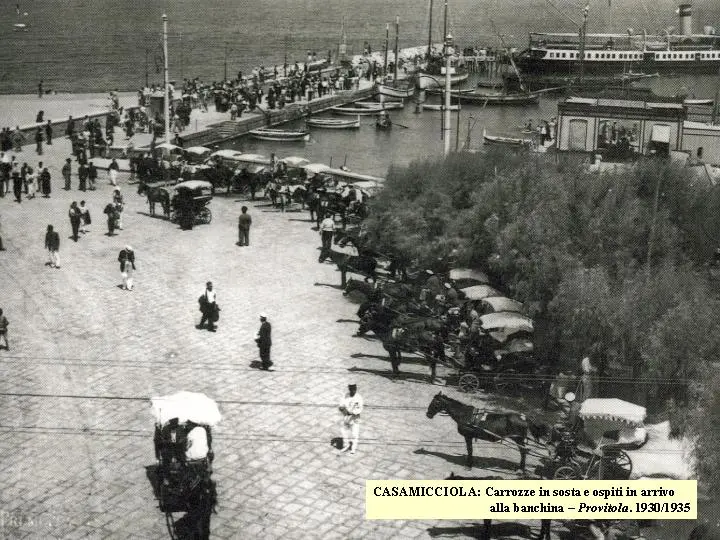
Rebirth and transformation
Casamicciola after 1883: the rebirth
After 1883 Casamicciola was reborn facing the sea. The 1884 Building Code, the first anti-seismic legislation of united Italy, introduced…
DiscoverVolcanic and geological history
The Volcanic Origins of Casamicciola
Casamicciola was born of Ischia's volcanoes. Around 56,000 years ago the Green Tuff eruption formed a caldera, then the Monte Epomeo block rose by…
DiscoverSources and further reading
- Giulio Grablovitz – Wikipedia
- Osservatorio Geodinamico di Casamicciola – INGV SISMOS
- Altri protagonisti: Giulio Grablovitz – INGV SISMOS
- Le trame di Casamicciola (G. Gugg), in Bloc Notes – Startmag
Last updated: