


At a glance
The Geodynamic, later Geophysical, Observatory of the Grande Sentinella was established by royal decree and founded in 1884 in the upper part of Casamicciola. Designed and directed by Giulio Grablovitz, it was a first-class observatory: its seismological recordings continued from 1889 to 1936.
Why it was founded in Casamicciola
After 1883 the need was felt for systematic study of the island's natural phenomena. At the request of the Geodynamic Commission, a royal decree established a “first-class” geodynamic observatory in Casamicciola, on a par with those at Rocca di Papa and Catania. For the town's rebirth in those years, read Casamicciola after 1883: the rebirth.
History of the observatory
According to INGV (Italy's National Institute of Geophysics and Volcanology), the observatory was founded in 1884 and inaugurated three years later. Giulio Grablovitz, a young scientist from Trieste already known for his studies of astronomy, earthquakes and tides, was called in to design and direct it. Building the main premises at the Grande Sentinella took a long time, amid administrative and scientific difficulties: in the meantime Grablovitz set up a station in the former Casina Reale (royal lodge) at Ischia Porto, which remained in use afterwards and where he carried out much of his work.
The observatory therefore had two seismic stations, Ischia Porto and the Grande Sentinella. Regular meteorological observations began on 1 January 1888; the seismological section was active from 1889 to 1936.
Grablovitz's instruments
In Casamicciola and Ischia Grablovitz experimented with original instruments: the seismic tank, horizontal pendulums derived from the Rebeur-Paschwitz model and regarded as forerunners of modern seismographs, water-based geodynamic levels and planispheres for calculating the distance and direction of epicentres. These instruments won him a gold medal at the 1906 International Exhibition in Milan. He also recorded the temperatures of the thermal waters and the tides.
A landmark of Italian seismology
The Casamicciola observatory was one of the first scientific outposts built by the newly unified Italian State to understand the phenomena of the earth. Today volcanic and seismic monitoring of the island is the responsibility of the Osservatorio Vesuviano, the Naples section of INGV, with networks of sensors for seismicity, ground deformation, waters and gases. To discover the island's geology, read The Volcanic Origins of Casamicciola.
Where it is and how to get there
The former observatory building stands on the Grande Sentinella hill, in the upper part of Casamicciola, near Via Grande Sentinella and Via Castanito. It can be reached by climbing from the centre or from Piazza Bagni. Before planning a visit inside, check with the Municipality whether the building is actually accessible.
Frequently asked questions
When was the Casamicciola Observatory founded?
Who directed the Observatory?
Is the observatory still in operation?
Also worth seeing
Famous people
Giulio Grablovitz, the Sentinella Seismologist
Giulio Grablovitz (Trieste 1846 – Ischia 1928) was the scientist called in to design and direct the Casamicciola Geodynamic Observatory, founded in…
DiscoverHistory and science
La Sentinella
La Sentinella is the hilly area of upper Casamicciola, divided into Grande and Piccola Sentinella and overlooking the gulf. After 1883 Giulio…
Discover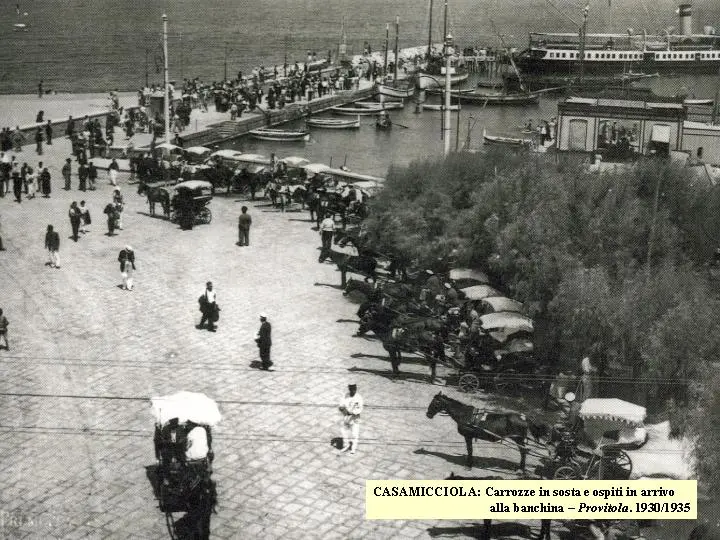
Rebirth and transformation
Casamicciola after 1883: the rebirth
After 1883 Casamicciola was reborn facing the sea. The 1884 Building Code, the first anti-seismic legislation of united Italy, introduced…
DiscoverVolcanic and geological history
The Volcanic Origins of Casamicciola
Casamicciola was born of Ischia's volcanoes. Around 56,000 years ago the Green Tuff eruption formed a caldera, then the Monte Epomeo block rose by…
DiscoverSources and further reading
- Osservatorio Geodinamico di Casamicciola – INGV SISMOS
- Altri protagonisti: Giulio Grablovitz – INGV SISMOS
- Giulio Grablovitz – Wikipedia
- Le trame di Casamicciola (G. Gugg), in Bloc Notes – Startmag
- Ischia – Dipartimento della Protezione Civile
Last updated: