


History of spa culture
The Rebirth of the Spa Tradition after 1883
At a glance
After 1883 Casamicciola was reborn facing the sea. A new building code, the first anti-seismic legislation of united Italy, guided the rise of new buildings: the Pio Monte opened its thermal hospice on the seafront in 1895, the mother church was reborn in 1896, and in Piazza Bagni the Gurgitello establishments continued to welcome guests.
A new season
In the summer of 1883 Casamicciola was one of the most popular spa resorts in Europe. After 1883 the town went through a long season of renewal that changed its face and gradually brought it towards the sea.
Rules for rebuilding
On 15 September 1883 the Ministry of Public Works set up the Commission for building regulations on the island of Ischia. Its recommendations were incorporated into the Building Code for the island's municipalities, in force from 15 September 1884, which presented itself as the first Italian anti-seismic study. New buildings were preferably to stand on level ground, away from the hills; buildings were not to exceed two storeys; for public buildings, “baraccate” structures in timber or iron were recommended. Extradosed vaults, loggias and domes disappeared, replaced by pitched roofs on trusses.
The town moves towards the sea
The Marina was built up with new buildings and districts, following the town plan drawn up by Domenico Lo Gatto in November 1883. The most important buildings were reborn further down: the parish church became the new basilica of Santa Maria Maddalena (1896), and the Pio Monte built its new thermal hospice on the seafront, opened in 1895, away from the Gurgitello spring that had fed its baths for almost three centuries. The town centre settled permanently around Piazza Marina, while Piazza Maio and Piazza Bagni remained the historic quarters of the upper town and of the spas.
The Piazza Bagni establishments
In Piazza Bagni the spas carried on working. The Bourbon Gurgitello establishment, now the Antiche Terme Belliazzi, according to its company history came through those years unscathed. Among the owners of the establishments on the square was Gioconda Gallinari in Manzi, from whom the Antiche Terme Manzi descend. The square, transformed and enlarged, did however become somewhat out of the way for the new tourist flows.
A patient recovery
The town grew again patiently: Casamicciola once more exceeded 4,000 inhabitants in the 1936 census. Those years also brought a new scientific focus: the building code suggested setting up an observatory in Casamicciola, later built at the Grande Sentinella, today's Geophysical Observatory. In the 20th century the spa vocation remained the town's identity, and in 1956 it added “Terme” to its name.
Further reading
The rebirth of the spas and hotels is told in Belle Époque Spas and Hotels and the story of the hospice in The Pio Monte and Thermal Care for the Poor. The town's urban transformation is the focus of Casamicciola after 1883: the rebirth.
Frequently asked questions
What changed for the spas after 1883?
What was Italy's first anti-seismic building code?
What are “baraccate” houses?
Are the Piazza Bagni spas still open?
Also worth seeing

Key places
Piazza Bagni
Piazza Bagni is the historic spa heart of Casamicciola Terme, a short distance from the harbour on the lower slopes of Epomeo. Here the waters of the…
Discover
Key places
Piazza Maio
Piazza Maio is the historic centre of the upper part of Casamicciola Terme, at around 130 metres above sea level on the slopes of Epomeo. A…
Discover
Key places
Piazza Marina
Piazza Marina is the heart of town life in Casamicciola Terme, overlooking the harbour where ferries and hydrofoils arrive. On the square stands the…
DiscoverHistoric spas
Pio Monte della Misericordia Complex
The Pio Monte della Misericordia complex is the old thermal hospice of Casamicciola Terme, founded in the early 17th century by the Gurgitello…
DiscoverHistoric spas
Antiche Terme Belliazzi
The Antiche Terme Belliazzi are the historic spa establishment in Piazza Bagni, Casamicciola Terme, built over the Gurgitello, the island's most…
DiscoverHistoric spas
Antiche Terme Manzi
The Antiche Terme Manzi are a historic spa establishment in Piazza Bagni, Casamicciola Terme, founded in 1863 by Luigi Manzi on the Gurgitello…
DiscoverHistory and science
Grande Sentinella Geophysical Observatory
The Geodynamic, later Geophysical, Observatory of the Grande Sentinella was established by royal decree and founded in 1884 in the upper part of…
Discover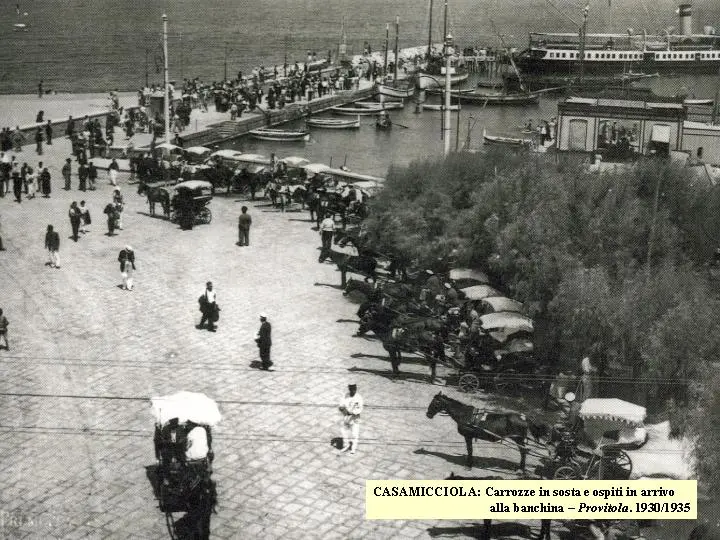
Rebirth and transformation
Casamicciola after 1883: the rebirth
After 1883 Casamicciola was reborn facing the sea. The 1884 Building Code, the first anti-seismic legislation of united Italy, introduced…
DiscoverHistory of spa culture
The Pio Monte and Thermal Care for the Poor
The Pio Monte della Misericordia, a Neapolitan charity founded in 1602, opened a hospice in Casamicciola from 1604 where the sick poor received…
DiscoverHistory of spa culture
Belle Époque Spas and Hotels
Between the late 19th century and the early decades of the 20th, Casamicciola rebuilt its spas and hotels closer to the sea. The new Pio Monte…
DiscoverChurches, faith and traditions
Basilica of the Sacro Cuore di Gesù and Santa Maria Maddalena Penitente
The basilica of the Sacred Heart of Jesus and St Mary Magdalene the Penitent is Casamicciola's mother church, on Via Roma near Piazzetta Funno…
DiscoverHistory of Casamicciola
The history of Casamicciola Terme is the story of its hot springs and its people. From the Pio Monte della Misericordia, which from 1604 treated the…
DiscoverSources and further reading
- Dipartimento della Protezione Civile – Il terremoto del 28 luglio 1883 a Casamicciola nell'isola d'Ischia (Servizio Sismico Nazionale, 1998)
- INGVterremoti – Casamicciola, 28 luglio 1883
- F. Capano, Il terremoto di Casamicciola del 1883: norme antisismiche e cupole tra storia e struttura, 'Ananke 91, 2020
- F. Capano, Casamicciola: un soggiorno privilegiato nel secolo della borghesia, 'Ananke 85, 2018
- Wikipedia – Terremoto di Casamicciola del 1883
- Catalogo generale dei Beni Culturali (SIGEC) – Ospizio termale del Pio Monte della Misericordia
- Antiche Terme Belliazzi – La nostra storia
- Wikipedia – Casamicciola Terme
Last updated: