


History of spa culture
Belle Époque Spas and Hotels
At a glance
Between the late 19th century and the early decades of the 20th, Casamicciola rebuilt its spas and hotels closer to the sea. The new Pio Monte hospice, opened in 1895, and hotels such as the Bellavista of 1906 rose on the seafront, while the historic Gurgitello establishments carried on working in Piazza Bagni.
A new map for holidays
After 1883 Casamicciola renewed itself. The new building rules advised building on level ground, away from the hills, and the town's centre moved from the upper town towards the Marina. It was here, between the late 19th and early 20th centuries, that the Belle Époque Casamicciola took shape.
The new Pio Monte on the seafront
The symbol of this rebirth was the new thermal hospice of the Pio Monte della Misericordia, opened on the coast in 1895. Designed by the engineer Giuseppe Florio using modern building methods, it was judged one of the foremost in Europe for its size and modernity: twelve dormitories, two bathing halls with eighty tubs, refectories, gardens and pinewoods across some 25,000 square metres. Next to it the Pio Monte also built a nursery school using the “baraccato” system: walls with a frame of chestnut trunks embedded in concrete, a technique of which many examples still survive in Casamicciola. The full story is in The Pio Monte and Thermal Care for the Poor.
Hotels by the sea
Hospitality, too, was reorganised near the coast. One example is the building at Via Principessa Margherita 32, completed in 1906: built as the Albergo Bellavista, later the Hotel Napoleon and Villa Salesiana, it stands out for its Ionic order and the statue of the Madonna and Child on the terrace cornice. Italy's national catalogue of cultural heritage records it as earmarked to become the Town Hall. In the following decades the coast continued to attract hoteliers: on Via Salvatore Girardi the former Hotel Italia, probably built in the 1930s, had a basement floor with thermal baths and enjoyed great fame in the 1960s.
The spas of Piazza Bagni
In Piazza Bagni the Gurgitello establishments carried on working. In the early 20th century an advertisement in the local magazine Il Casamicciola presented the Belliazzi establishment, now the Antiche Terme Belliazzi, with forty first-class and twenty second-class cubicles. Next door was the Manzi family's establishment, from which the Antiche Terme Manzi descend.
Science and a fragile land
The Belle Époque was also an era of science: the building regulations of 1884 suggested setting up an observatory in Casamicciola, later built at the Grande Sentinella: this is the Geophysical Observatory.
Into the 20th century
After the Second World War the island's tourism took new directions and the town, while keeping its spa vocation, was no longer the sole focus of holidays on Ischia. In 1956, to underline the value of its waters, the Municipality added “Terme” (spa) to its name. The story of the rebirth is in The Rebirth of the Spa Tradition after 1883; that of the previous era in Casamicciola, a European Spa Resort.
Where it is
To find these places, simply stroll between Piazza Marina, Corso Luigi Manzi and Via Principessa Margherita, then climb up towards Piazza Bagni.
Frequently asked questions
What remains of the Belle Époque in Casamicciola?
Why did hotels and spas move towards the sea after 1883?
What is a “casa baraccata”?
Also worth seeing

Key places
Piazza Bagni
Piazza Bagni is the historic spa heart of Casamicciola Terme, a short distance from the harbour on the lower slopes of Epomeo. Here the waters of the…
Discover
Key places
Piazza Marina
Piazza Marina is the heart of town life in Casamicciola Terme, overlooking the harbour where ferries and hydrofoils arrive. On the square stands the…
DiscoverHistoric spas
Antiche Terme Belliazzi
The Antiche Terme Belliazzi are the historic spa establishment in Piazza Bagni, Casamicciola Terme, built over the Gurgitello, the island's most…
DiscoverHistoric spas
Antiche Terme Manzi
The Antiche Terme Manzi are a historic spa establishment in Piazza Bagni, Casamicciola Terme, founded in 1863 by Luigi Manzi on the Gurgitello…
DiscoverHistoric spas
Pio Monte della Misericordia Complex
The Pio Monte della Misericordia complex is the old thermal hospice of Casamicciola Terme, founded in the early 17th century by the Gurgitello…
DiscoverHistory and science
Grande Sentinella Geophysical Observatory
The Geodynamic, later Geophysical, Observatory of the Grande Sentinella was established by royal decree and founded in 1884 in the upper part of…
DiscoverHistory of spa culture
Casamicciola, a European Spa Resort
In the 19th century Casamicciola became a spa resort known throughout Europe. Villas and grand hotels rose around the Piazza Bagni spas and on the…
DiscoverHistory of spa culture
The Rebirth of the Spa Tradition after 1883
After 1883 Casamicciola was reborn facing the sea. A new building code, the first anti-seismic legislation of united Italy, guided the rise of new…
DiscoverHistory of spa culture
The Pio Monte and Thermal Care for the Poor
The Pio Monte della Misericordia, a Neapolitan charity founded in 1602, opened a hospice in Casamicciola from 1604 where the sick poor received…
Discover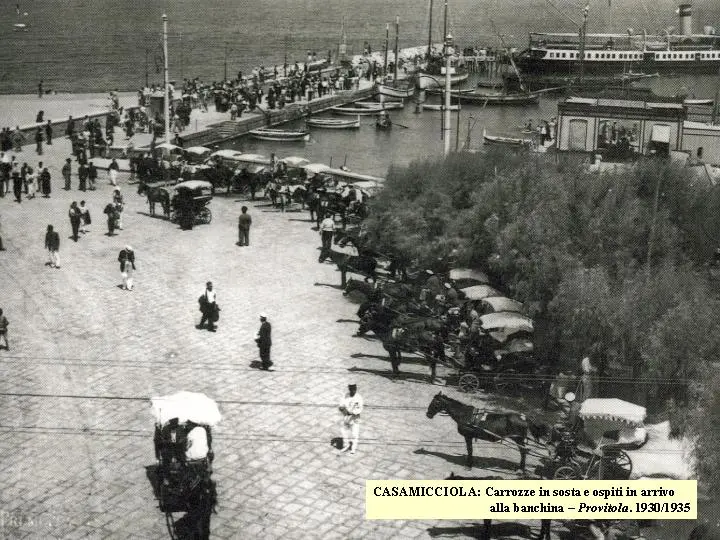
History of Casamicciola
The history of Casamicciola Terme is the story of its hot springs and its people. From the Pio Monte della Misericordia, which from 1604 treated the…
DiscoverSources and further reading
- F. Capano, Casamicciola: un soggiorno privilegiato nel secolo della borghesia, 'Ananke 85, 2018
- F. Capano, Il terremoto di Casamicciola del 1883: norme antisismiche e cupole tra storia e struttura, 'Ananke 91, 2020
- Catalogo generale dei Beni Culturali (SIGEC) – Hotel Napoleon (ex), già Albergo Bellavista
- Catalogo generale dei Beni Culturali (SIGEC) – Hotel Italia (ex)
- Catalogo generale dei Beni Culturali (SIGEC) – Ospizio termale del Pio Monte della Misericordia
- Catalogo generale dei Beni Culturali (SIGEC) – Asilo S. Maria della Provvidenza
- Antiche Terme Belliazzi – La nostra storia
- Wikipedia – Casamicciola Terme
Last updated: